Matières à vivre, échanges de regards. 30 ans de GD Architectes
Matières à vivre, échanges de regards. 30 ans de GD Architectes
Exposition du 22 janvier au 2 février 2026
Galerie-c, Neuchâtel
E. Léopold-Robert 1A
CH–2000 Neuchâtel
Avec Guillaume Chesnel
Jonathan Delachaux
Nicolas Darrot
Fiona Djukanovic
Claire Frachebourg
Tiziano Foucault-Gini
Matthieu Gafsou
Henry Glavin
Lukas Hoffmann
Malik Jeannet
Gian Losinger
Christian Lutz
Benjamin Pfeiffer
Michael Rampa
Denis Roueche
Maude Schneider
Robin Wen
Vernissage public le 22 janvier 2026 dès 18h00
Perhaps poetry is unexpected truth. Its appearance requires silence. Architecture has the artistic task of giving form to this silent expectation. – Peter Zumthor
Art and architecture are disciplines that have always had a close and complex relationship. Far from being new, this dialogue has developed over time through mutual influences, sometimes marked by tension, competition or mutual fascination, to the ideal of the total work of art, where the disciplines merge and complement each other. Engaging with space, time, materials and use, art and architecture develop distinct languages and intentions that often explore similar questions.
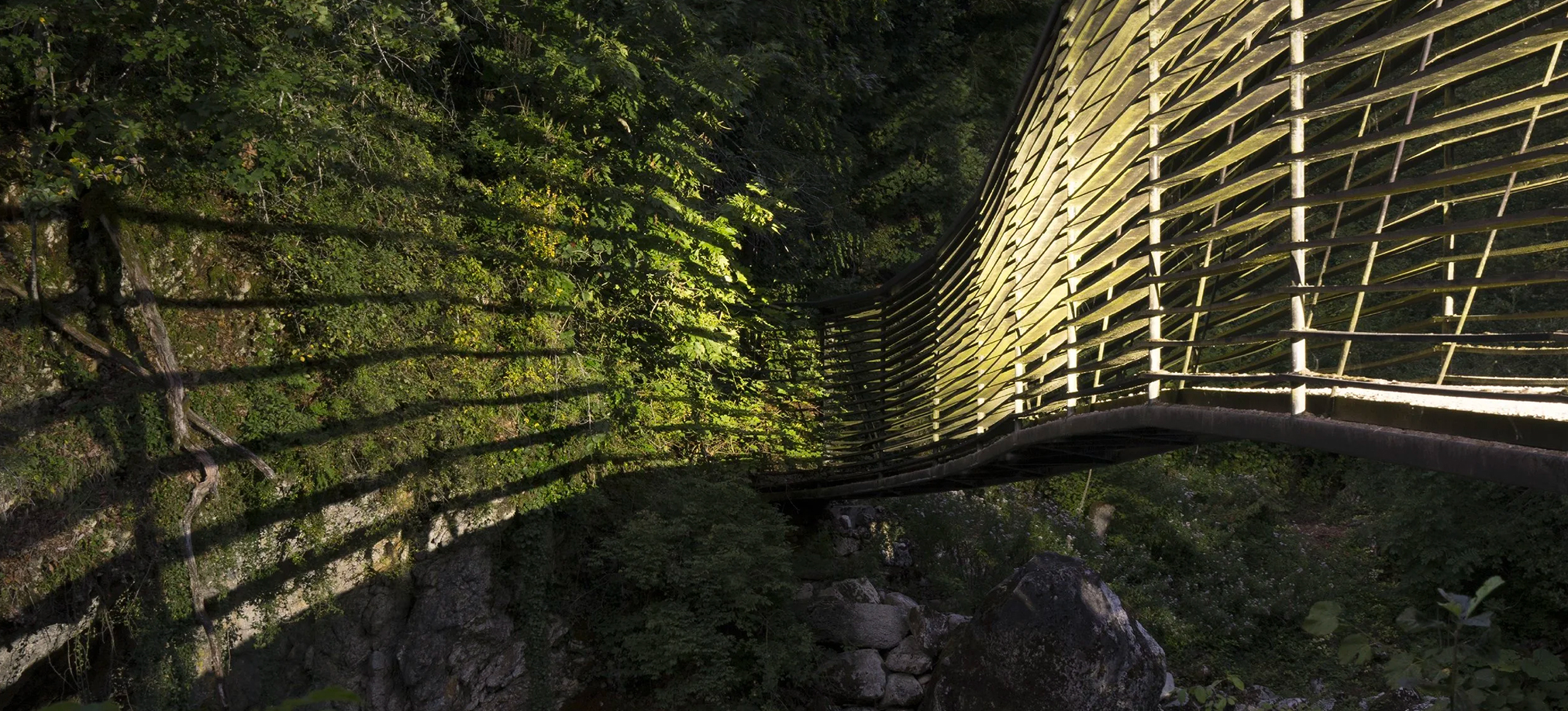
To mark the 30th anniversary of the Neuchâtel-based GD architects firm, this exhibition celebrates this connection by inviting artists to create a work that engages in dialogue with one of the architectural projects completed by the firm: the footbridge in the Areuse Gorges, the Maladière stadium, the Riviera-Chablais Hospital, the Riveraine Sports Hall, the Tissot-Arena Stadiums in Biel, the IDHEAP in Chavannes-près-Renens and many others. It is a deliberately unsettling proposition: to offer an existing building, which has been designed, built and completed, as the starting point for an artistic endeavour. This unique constraint invites us to approach architecture differently, no longer as a fixed or purely functional object, but as a living material, laden with stories, uses, transformations and memories.
This invitation reveals the extent to which architecture and the environment, whether built or natural, occupy a central place in the concerns of many artists. For Lukas Hoffmann, Christian Lutz, Matthieu Gafsou and Robin Wen, the built environment becomes a privileged field of observation, revealing the links between form, landscape, use and perception. The building is no longer just a setting, but a subject in its own right, sometimes questioned in terms of its territorial integration, sometimes in terms of its relationship to the body, to image or to the surrounding nature.
Over the course of thirty years of design, GD architects’ projects have stood the test of time. They have been inhabited, traversed, appropriated and transformed by those who live, work or frequent them. Artists are thus invited to deconstruct the completed project, revealing its hidden layers, its initial intentions and its actual uses. By taking a fresh look at these architectures, they question what happens to a building once it is delivered, when the architectural work is confronted with everyday reality.
For some artists, such as Guillaume Chesnel, Fiona Djukanovic, Gian Losinger and Michael Rampa, this confrontation primarily gives rise to aesthetic concerns. Form, materiality, lines, colours, light and volumes become anchor points for a sensitive interpretation of architecture. For Tiziano Foucault-Gini, it is more the symbols conveyed by architecture, as well as its history and the narratives it carries, that feed into the interpretation. Other approaches are part of a more sociological reflection, where form and function are linked. For Claire Frachebourg, Maude Schneider, Benjamin Pfeiffer and Peter Aerschmann, architecture becomes a tool for analysing the uses, behaviours and social dynamics that it generates or accommodates. Denis Roueche introduces a touch of humour with his sculptures, which play on the discrepancies between form and function. Finally, for some, the link between art and architecture forms a permanent foundation for their practice. This is the case for Nicolas Darrot and Malik Jeannet, whose installation, on an architectural scale and fully functional, is designed as a sculptural work, expressing his systemic research on how we view our relationships with our immediate environment. Jonathan Delachaux takes this idea even further by developing a work based on augmented reality, revealing the situational and architectural dimensions of the space through an immersive experience that superimposes the real and the virtual.
Through this diversity of proposals, the exhibition highlights the richness of artistic perspectives on architecture, not as a closed object, but as an open process in constant interaction with time, uses and individuals. These artistic interventions thus invite us to rethink our relationship with the spaces we inhabit and to consider architecture as a field of experimentation, projection and questioning that is constantly evolving.

